
-

 Vendor:National Safety Compliance
Lockout/Tagout Safety Training | Video & Program (English & Spanish)
Regular price From $85.00Regular price -

 Vendor:National Safety Compliance
All Access Pass (English and Spanish)
Regular price $3,495.00Regular price -
 Vendor:National Safety Compliance
Lockout/Tagout Training Booklets (pkg of 10)
Regular price $15.00Regular price -
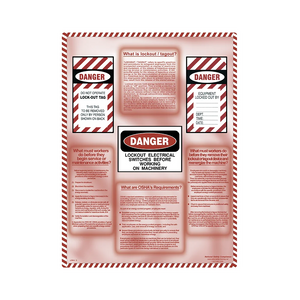 Vendor:National Safety Compliance
Lockout/Tagout Informational Poster
Regular price $15.00Regular price -
 Vendor:National Safety Compliance
Lock Things Up, Don't Forget Safety Poster
Regular price $15.00Regular price -
 Vendor:National Safety Compliance
Lockout, Potential Danger Safety Poster
Regular price $15.00Regular price


Lockout / tagout training requirements
OSHA's control of hazardous energy standard, 29 CFR 1910.147, requires an energy control program with written procedures, and training that differs by role. Getting the roles right is what most programs get wrong:
| Role | Who they are | Training depth |
|---|---|---|
| Authorized employee | Applies locks and tags to service or maintain equipment | Full training: hazardous energy recognition, magnitude of the energy available, and the methods and means to isolate and control it |
| Affected employee | Operates equipment being serviced, or works in the area | Purpose and use of the procedures — and never to restart a locked-out machine |
| Other employee | Anyone whose work may take them near a lockout | Awareness of the procedures and the prohibition on tampering with locks or tags |
The standard also requires a periodic inspection at least annually, conducted by an authorized employee other than the one using the procedure being inspected, plus retraining whenever job assignments, machines, processes or procedures change — or whenever an inspection reveals a deviation. If you use tagout-only where energy isolating devices can't be locked, employees need additional training on the limitations of tags.
The program below delivers the instruction and the records. Your machine-specific written energy control procedures are yours to author and keep current.
What's included
- Training video in English and Spanish
- PowerPoint presentation for classroom delivery
- Compliance manual and training outline
- Employee quiz and answer key
- Completion certificates and wallet / ID cards
- Attendance log and sign-in form
- Supplemental printouts
Compare formats
| Format | Access | Starting price | Best for |
|---|---|---|---|
| Streaming | 1-month or 1-year subscription, instant online access | $85 for 1 month, $195 for 1 year | Retraining after a procedure or equipment change |
| MP4 download | Annual license, tiered by employee count. Both English and Spanish files included. | Varies by employee count | Hosting on your own LMS, file server or SharePoint |
| USB or DVD | One-time purchase, physical media, no internet required | $225 | Maintenance shop and plant classroom sessions |
What the training covers
- Forms of hazardous energy: electrical, mechanical, hydraulic, pneumatic, chemical, thermal and gravitational
- Stored and residual energy — capacitors, springs, raised loads, pressurized lines and rotating flywheels
- The six steps of a lockout: prepare, shut down, isolate, apply locks and tags, release stored energy, verify
- Verification — the step most often skipped, and why an attempted restart is part of it
- Locks, tags, hasps and group lockout boxes
- Group lockout and multi-employer work
- Shift change and continuity of lockout protection
- Removing another person's lock: when it is permitted and what the procedure requires
- The difference between lockout and tagout, and the limitations of tags
Lockout / tagout training questions
Who is considered an "authorized employee" under LOTO?
An authorized employee is someone who locks or tags out machines or equipment in order to perform servicing or maintenance on it. Affected employees are those who operate equipment being serviced or work in the area. Both groups require training — at different depths — and the program covers the responsibilities of each.
Does this training satisfy OSHA requirements?
It covers the training the standard requires. OSHA also requires a written energy control program and equipment-specific procedures, which your organization develops for your own machines. A video cannot supply a procedure for a press or conveyor it has never seen; the compliance manual gives you the framework to write them.
How often is lockout / tagout retraining required?
Whenever there is a change in job assignments, in the machines or processes that present a new hazard, or in the energy control procedures themselves — and whenever a periodic inspection reveals a deviation or inadequacy. Separately, the standard requires a periodic inspection at least annually, performed by an authorized employee other than the one using the procedure being inspected.
What is the difference between lockout and tagout?
A lockout physically prevents the energy isolating device from being operated. A tagout only warns against operating it. OSHA permits tagout-only where a device is not capable of being locked out, but the employer must then demonstrate full employee protection and provide additional training on the limitations of tags — a tag is a warning, not a restraint.
Can I remove someone else's lock?
Only under a specific procedure. The standard permits lock removal by someone other than the person who applied it when that person is unavailable, but it requires verification that the person is not at the facility, all reasonable efforts to contact them, and notification before they resume work. That procedure has to be written down in advance — not improvised on shift.
Why is verification the step most often skipped?
Because the machine looks off. Verification means confirming the isolation actually worked — attempting a restart, testing for voltage, checking gauges, releasing stored energy in springs, capacitors, hydraulic lines and raised loads. Incidents involving equipment that was locked out but never verified are among the most common serious LOTO failures.
Reinforce the classroom session
Employee training booklets in packs of 10 give maintenance crews a reference to keep. Lockout / tagout posters cover the procedure steps and the do-not-operate message for placement at panels and machine stations.