
-

 Vendor:National Safety Compliance
Fall Protection Safety Training | Video & Program (English & Spanish)
Regular price From $85.00Regular price -

 Vendor:National Safety Compliance
All Access Pass (English and Spanish)
Regular price $3,495.00Regular price -
 Vendor:National Safety Compliance
Fall Protection Training Booklets (pkg of 10)
Regular price $15.00Regular price -
 Vendor:National Safety Compliance
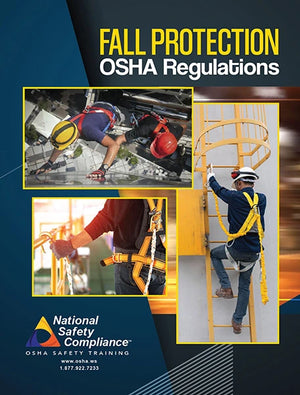
Fall Protection Standards & Regulations
Regular price $40.00Regular price


At what height is fall protection required?
The trigger height depends on which OSHA standard applies to the work, which is the single most common point of confusion:
| Work type | Fall protection required at | Standard |
|---|---|---|
| Construction | 6 feet above a lower level | 1926.501 |
| General industry | 4 feet above a lower level | 1910.28 |
| Scaffolds | 10 feet above a lower level | 1926.451 |
| Steel erection | 15 feet above a lower level | 1926.760 |
| Shipyards | 5 feet | 1915 |
| Longshoring | 8 feet | 1918 |
| Over dangerous equipment | Any height | 1910.28 / 1926.501 |
Regardless of height, work over dangerous equipment requires protection at any elevation, and ladders, stairways and openings carry their own requirements.
Training requirements
In construction, 29 CFR 1926.503 requires that a competent person train each employee exposed to fall hazards, and that the employer prepare a written certification record identifying the employee, the training date and the trainer's signature. Retraining is required when workplace conditions change, when equipment changes, or when an employee's performance shows the earlier training was not effective.
The program below delivers the classroom instruction and the certification record. Selecting anchor points and inspecting your specific harnesses and lanyards is site work for your competent person.
What's included
- Training video in English and Spanish
- PowerPoint presentation for classroom delivery
- Compliance manual and training outline
- Employee quiz and answer key
- Completion certificates and wallet / ID cards
- Attendance log and sign-in form — the written certification record
- Supplemental printouts
Compare formats
| Format | Access | Starting price | Best for |
|---|---|---|---|
| Streaming | 1-month or 1-year subscription, instant online access | $85 for 1 month, $195 for 1 year | Training a crew now, or continuous onboarding |
| MP4 download | Annual license, tiered by employee count. Both English and Spanish files included. | Varies by employee count | Hosting on your own LMS, file server or SharePoint |
| USB or DVD | One-time purchase, physical media, no internet required | $225 | Jobsite trailers and toolbox talks |
What the training covers
- Recognizing fall hazards: unprotected edges, leading edges, holes and openings, roofs and skylights
- Guardrails, safety nets and personal fall arrest systems — when each is appropriate
- The components of a personal fall arrest system: full-body harness, connectors, lanyards, deceleration devices and anchorages
- Anchor point strength requirements and how to identify a suitable anchorage
- Fall clearance, free fall distance and swing fall
- Inspecting harnesses and lanyards, and when to remove equipment from service
- Rescue planning and suspension trauma after an arrested fall
- Ladder and stairway fall hazards
Fall protection training questions
Does this cover both construction and general industry?
Yes. The program covers both 1910 Subpart D (general industry, 4-foot threshold) and 1926 Subpart M (construction, 6-foot threshold), which makes it suitable for employers in either sector and for those with employees who work across both environments.
Does this training satisfy OSHA requirements?
It covers the classroom training the standards require. Two things remain yours: OSHA requires a site-specific fall protection plan for certain construction operations, developed by a qualified person at your organization, and construction training must be delivered by a competent person — so the session should be run or overseen by someone in your organization who meets that definition.
Who is a "competent person" for fall protection training?
Someone capable of identifying existing and predictable fall hazards in the work area and who has authorization to take prompt corrective action to eliminate them. That authority is the part employers often miss — knowledge alone is not enough; the person must be empowered to stop the work.
How often is fall protection retraining required?
There is no fixed calendar interval in 1926.503. Retraining is required when workplace conditions change, when fall protection systems or equipment change, or when an employee's performance indicates the original training was not effective. Many employers run an annual refresher anyway, since it is the simplest way to demonstrate an ongoing program.
What records do we need to keep?
A written certification record identifying the employee trained, the date of training, and the signature of the trainer or the employer. The attendance log, quiz and completion certificates included with the program are built to produce exactly that record.
Does a harness alone satisfy the requirement?
No. A full-body harness is one component of a personal fall arrest system, which also needs a compliant anchorage, connectors, and a lanyard or deceleration device sized so the worker cannot contact a lower level. The training covers anchor strength, free fall distance, fall clearance and swing fall, plus the rescue plan you need for a worker left suspended after an arrested fall.
Reference materials
Employee training booklets in packs of 10 give crews something to keep after the session, and the Fall Protection Standards & Regulations booklet puts the applicable regulatory text in the site office.