
-

 Vendor:National Safety Compliance
Forklift Safety Training | Video & Program (English & Spanish)
Regular price From $85.00Regular price -

 Vendor:National Safety Compliance
Forklift: Construction Safety Training | Video & Program (English & Spanish)
Regular price From $85.00Regular price -
 Vendor:National Safety Compliance
Forklift Load Stability Training | Video & Program (English & Spanish)
Regular price From $85.00Regular price -

 Vendor:National Safety Compliance
All Access Pass (English and Spanish)
Regular price $3,495.00Regular price -
 Vendor:National Safety Compliance
Forklift Safety Employee Training Booklets (pkg of 10)
Regular price $15.00Regular price -
 Vendor:National Safety Compliance
Forklift Safety: Construction Employee Training Booklets (pkg of 10)
Regular price $15.00Regular price -
 Vendor:National Safety Compliance
Forklift Load Stability Training Booklets (pkg of 10)
Regular price $15.00Regular price -
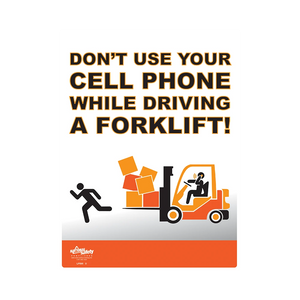 Vendor:National Safety Compliance
Do Not Use Mobile Phone While Driving Forklift Safety Poster
Regular price $15.00Regular price -
 Vendor:National Safety Compliance
Forklift Driving Keeping Low... Safety Poster
Regular price $15.00Regular price -
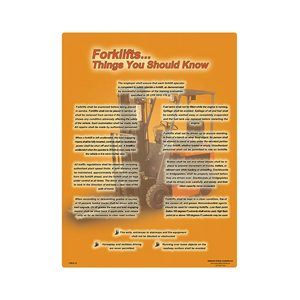 Vendor:National Safety Compliance
Forklift... Things You Should Know Poster
Regular price $15.00Regular price


Forklift operator training requirements
OSHA's powered industrial truck standard, 29 CFR 1910.178(l), requires employers to train forklift operators in three parts: formal instruction, practical hands-on training, and an evaluation of the operator in the workplace. The rule has been in force since March 1, 1999. Each operator must be re-evaluated at least once every three years, and retrained sooner after an accident or near-miss, when an operator is observed operating unsafely, when workplace conditions change, or when the operator is assigned a different type of truck. The employer certifies each operator once the evaluation is complete.
The programs below provide the formal instruction, along with the documents you need to run the session and keep records. The hands-on practical training and the workplace evaluation are performed by you, on your own site with your own equipment. OSHA's Powered Industrial Trucks eTool describes the same three-part structure.
What's included with every training program
- Training video in English and Spanish
- PowerPoint presentation for classroom delivery
- Compliance manual
- Training outline
- Employee quiz and answer key
- Completion certificates and wallet / ID cards
- Attendance log and sign-in form
- Supplemental printouts, including inspection checklists
The quiz, attendance log, certificates and wallet cards are the recordkeeping side of the program — what you use to document that the training took place before you attach your own practical evaluation.
Compare formats
| Format | Access | Starting price | Best for |
|---|---|---|---|
| Streaming | 1-month or 1-year subscription, instant online access | $85 for 1 month, $195 for 1 year | Training a crew now, or continuous onboarding |
| MP4 download | Annual license, tiered by employee count (up to 50, through 1,001+). Both English and Spanish files are included regardless of which you select. | Varies by employee count | Hosting on your own LMS, file server or SharePoint |
| USB or DVD | One-time purchase, physical media, no internet required | $225 | Classrooms, trailers and jobsites with unreliable connectivity |
Which forklift program do you need?
| Program | Who it's for | Focus |
|---|---|---|
|
Forklift Safety 25-minute video Updated August 2026 |
General industry — warehousing, distribution, manufacturing. New operators, employees who work near forklifts, safety trainers, and anyone due for refresher training | Complete operator training: forklift types and classes, training and general requirements, power sources, inspections, operations, traveling, loading, high tiering, truck trailers and railroad cars, tipping |
|
Forklift Safety — Construction Version 25-minute video Updated August 2026 |
Construction worksites — new construction employees who work with or near forklifts, and new operators in a construction setting. Also suitable for train-the-trainer use | The same operator training filmed and framed for construction, adding jobsite conditions and terrain |
| Forklift Load Stability | New or experienced operators in warehouse, manufacturing, construction and distribution environments, plus managers and supervisors. Pairs with Forklift Safety for a complete program | Forklift capacity and data plate interpretation, load center, how load position affects capacity, asymmetrical loads, the stability triangle, tip-over causes and falling-load hazards |
The Forklift Safety and Forklift Safety — Construction Version programs were both updated in August 2026.
What the training covers
- Forklift types and classes — OSHA divides powered industrial trucks into seven classes, spanning counterbalance trucks, narrow-aisle reach trucks, order pickers, motorized pallet jacks and rough-terrain forklifts
- Pre-operation and daily inspection, and reading the forklift data plate
- Load center, rated capacity, center of gravity and the stability triangle
- Traveling, turning, ramps and grades, high tiering, and pedestrian awareness
- Loading and unloading truck trailers and railroad cars
- Power sources, refueling and battery charging, parking and shutdown
- Causes of tip-over and what an operator should do
Forklift training questions
Does this training satisfy OSHA requirements?
Yes — for the classroom portion. These courses cover the formal instruction required by OSHA Standard 29 CFR 1910.178 for powered industrial truck operators. OSHA also requires a hands-on practical evaluation component, which must be conducted separately by a qualified trainer (someone experienced and knowledgeable) in your workplace.
Can a video course by itself certify a forklift operator?
No. Formal instruction is one of three required parts. After the classroom session, the employer provides practical hands-on training and evaluates the operator's performance in the workplace — and it is the employer who then certifies the operator. No video, online course or third party can complete that step for you.
How often do operators need retraining?
Every 3 years, or sooner if operations or equipment change, or after an incident. Re-evaluation is also triggered when an operator is observed operating unsafely, or when they are assigned a different type of truck.
Is free forklift training available?
Free forklift videos and awareness material are widely available and can be useful for general education. What they do not include is the trainer material and documentation an employer needs to run and record a compliant session — the lesson outline, employee quiz and answer key, attendance log, completion certificates and wallet cards. They also don't cover the practical training and workplace evaluation, which remain the employer's responsibility either way.
What are five forklift safety rules every operator should follow?
- Inspect before every shift. Check forks, tires, hydraulics, horn, lights and brakes, and take the truck out of service if anything fails.
- Know the data plate and never exceed rated capacity. Rated capacity applies only at the load center shown on that truck's data plate — commonly 24 inches, but read the plate rather than assuming. Move the load center out and capacity drops.
- Travel with the load low and tilted back. Keep the forks low — commonly 4–6 inches off the ground, or whatever height your employer's procedures and the truck manufacturer's operating instructions specify — with the mast tilted back to keep the load inside the stability triangle.
- Watch for pedestrians. Sound the horn at intersections and blind corners, make eye contact, and never let anyone walk or stand under raised forks.
- Park properly. Forks flat on the floor, controls neutral, parking brake set, power off — and chock the wheels when loading a trailer.
These are general good-practice rules. Your own operating procedures and the manufacturer's instructions for each specific truck always take precedence.
What is the difference between Streaming, MP4, USB and DVD?
Streaming gives you instant online access from any device for the classroom — no download required. MP4 is a download you host on your own platform such as an LMS, file server or SharePoint. USB and DVD are physical media shipped to you, best for classroom training where internet access is limited or unavailable. Note that the video on the USB is encrypted and licensed to play only from the USB, so it cannot be copied and shared.
Do streaming and MP4 purchases automatically renew?
Streaming and MP4 are prepaid subscriptions that automatically renew at the end of each term at the then-current price unless canceled. You can view, manage or cancel a subscription at any time through your account portal. USB and DVD are one-time purchases and do not renew.
What documentation is provided for compliance recordkeeping?
Each program includes a compliance manual, employee quiz and answer key, completion certificates, wallet / ID cards, an attendance log and a training outline — everything needed to document training and maintain OSHA compliance records.
Reinforce the classroom session
Employee training booklets in packs of 10, in English and Spanish, give operators something to keep after the session. Workplace posters cover the day-to-day reminders — keeping the forks low and slow, no mobile phones while operating, and load handling basics.