
-

 Vendor:National Safety Compliance
Heat Stress Safety Training | Video & Program (English & Spanish)
Regular price From $85.00Regular price -

 Vendor:National Safety Compliance
All Access Pass (English and Spanish)
Regular price $3,495.00Regular price -
 Vendor:National Safety Compliance
Heat Stress Training Booklets (pkg of 10)
Regular price $15.00Regular price -
 Vendor:National Safety Compliance
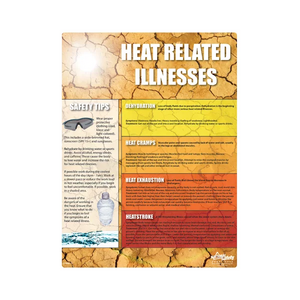
Heat Stress Safety Poster
Regular price $15.00Regular price


Heat stress and employer obligations
There is no single OSHA standard for heat. OSHA enforces heat hazards under the General Duty Clause, Section 5(a)(1) of the OSH Act, which requires employers to keep the workplace free of recognized hazards likely to cause serious harm — and heat illness is a recognized hazard. OSHA also runs a National Emphasis Program on outdoor and indoor heat, which means inspections can be opened on heat exposure specifically. OSHA's heat illness prevention resources set out the water, rest and shade framework these materials follow.
Because there is no prescriptive training rule, what protects workers — and what an inspector looks for — is a documented program: workers and supervisors trained to recognize heat illness, an acclimatization plan for new and returning workers, and records showing the training happened. The program below provides the instruction and the documentation.
What's included
- Training video in English and Spanish
- PowerPoint presentation for classroom delivery
- Compliance manual and training outline
- Employee quiz and answer key
- Completion certificates and wallet / ID cards
- Attendance log and sign-in form
- Supplemental printouts
Compare formats
| Format | Access | Starting price | Best for |
|---|---|---|---|
| Streaming | 1-month or 1-year subscription, instant online access | $85 for 1 month, $195 for 1 year | Training ahead of the summer season |
| MP4 download | Annual license, tiered by employee count. Both English and Spanish files included. | Varies by employee count | Hosting on your own LMS, file server or SharePoint |
| USB or DVD | One-time purchase, physical media, no internet required | $225 | Field crews and jobsite trailers |
What the training covers
- Risk factors — temperature and humidity, radiant heat, workload, clothing and PPE, and individual factors
- Acclimatization — why new and returning workers are at highest risk in their first days, and how to build exposure gradually
- Warning signs of heat rash, heat cramps, heat exhaustion and heat stroke, and how to tell them apart
- First aid response, and which symptoms are a medical emergency
- Water, rest and shade — practical scheduling and hydration guidance
- Indoor heat sources: furnaces, boiler rooms, kitchens, laundries and unventilated warehouses
- Supervisor responsibilities and buddy-system monitoring
Heat stress training questions
Is heat stress training required by OSHA?
OSHA does not currently have a final, federal-level standard dedicated solely to heat illness prevention. Employers are still required under OSHA's General Duty Clause to provide a workplace free from recognized hazards, and heat stress is a recognized and frequently cited hazard — particularly in outdoor and high-heat industries. Several states have their own heat illness prevention standards with specific training requirements, so check the rules that apply where you operate.
What is the difference between heat exhaustion and heat stroke?
Heat exhaustion is the milder illness — heavy sweating, weakness, dizziness and nausea — and can usually be managed by moving the worker to a cool area, hydrating and resting. Heat stroke is a medical emergency. It occurs when the body's temperature regulation fails, and is often marked by a high body temperature, confusion, and hot dry skin or a sudden stop in sweating. Heat stroke requires immediate emergency medical care. Knowing which is which is the single most important thing this training teaches.
Does heat stress only affect outdoor workers?
No. Indoor heat is a significant hazard in foundries, bakeries, commercial kitchens, laundries, boiler rooms and unventilated warehouses, where radiant heat sources and poor airflow can produce conditions worse than outdoors. The program covers both indoor and outdoor exposure.
Why does acclimatization matter so much?
A large share of serious heat illness happens in a worker's first few days on a hot job — new hires, workers returning from leave, and crews hitting the first heat wave of the season. Acclimatization means building heat exposure up gradually over roughly a week rather than putting someone straight onto a full shift in full sun.
Who should attend the training?
Both workers and supervisors. Workers need to recognize symptoms in themselves and their coworkers; supervisors need to know how to schedule water, rest and shade, run an acclimatization plan, and respond when someone goes down. The program covers supervisor responsibilities and buddy-system monitoring alongside the worker material.
Reinforce the classroom session
Employee training booklets in packs of 10 give crews something to keep, and the heat stress workplace poster puts the warning signs where people can see them through the season.