
-
 Vendor:National Safety Compliance
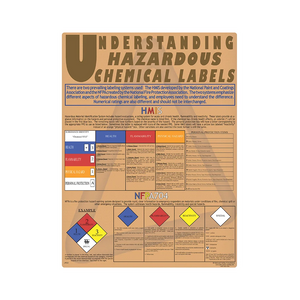
Understanding Labels Safety Poster
Regular price $15.00Regular price -
 Vendor:National Safety Compliance
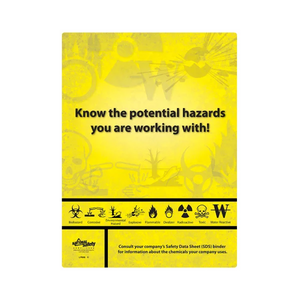
Know Your Chemicals Poster
Regular price $15.00Regular price
Hazard communication training requirements
OSHA's hazard communication standard, 29 CFR 1910.1200 — often called HazCom or the Right-to-Know standard — is consistently among OSHA's most-cited standards. It requires four things of employers whose workers may be exposed to hazardous chemicals:
- A written hazard communication program
- A chemical inventory and an accessible safety data sheet for every hazardous chemical
- Labels on shipped containers, and labeling on workplace containers
- Training at the time of initial assignment, and again whenever a new chemical hazard is introduced into the work area
Note there is no annual retraining requirement in HazCom — the trigger is a new hazard, not the calendar. OSHA updated the standard in 2024 to align with GHS Revision 7, with employer obligations to update workplace labeling and retrain phased in across 2026 and 2028, so new labels arriving from suppliers are themselves a retraining trigger.
Which HazCom program do you need?
| Program | Focus |
|---|---|
| Hazard Communication | The full standard — written program, chemical inventory, labels, SDS, employee rights and the GHS framework |
| HazCom: Chemical Labels | Reading GHS labels in depth — the six required elements, the nine pictograms, signal words, hazard and precautionary statements, and workplace container labeling |
| HazCom: Safety Data Sheets | Working the 16-section SDS — where to find first aid, handling, exposure limits, PPE and spill response when you need them fast |
What's included with every training program
- Training video in English and Spanish
- PowerPoint presentation for classroom delivery
- Compliance manual and training outline
- Employee quiz and answer key
- Completion certificates and wallet / ID cards
- Attendance log and sign-in form
- Supplemental printouts
Compare formats
| Format | Access | Starting price | Best for |
|---|---|---|---|
| Streaming | 1-month or 1-year subscription, instant online access | $85 for 1 month, $195 for 1 year | Training when a new chemical arrives |
| MP4 download | Annual license, tiered by employee count. Both English and Spanish files included. | Varies by employee count | Hosting on your own LMS, file server or SharePoint |
| USB or DVD | One-time purchase, physical media, no internet required | $225 | Shop floor and plant classroom sessions |
What the training covers
- GHS pictograms — each of the nine is a black hazard symbol on a white background inside a red diamond border, and what each one signals
- The six required elements of a GHS label: product identifier, signal word, hazard statements, pictograms, precautionary statements, and supplier information
- Signal words — why "Danger" and "Warning" are not interchangeable
- Workplace container labeling and the alternative labeling options employers may use
- The 16 sections of a safety data sheet, and which ones matter in an emergency
- Physical versus health hazards, and routes of exposure
- Where the written program, chemical inventory and SDS collection are kept, and employee right of access
- Safe handling, storage and incompatible chemicals
Hazard communication training questions
How often is hazard communication training required?
At the time of initial assignment, and whenever a new chemical hazard is introduced into the work area. There is no annual requirement in the standard itself, though annual refresher training is widely considered best practice and is a straightforward way to keep employees current — particularly while GHS Revision 7 label changes are phasing in.
Do I need all three courses, or just the main one?
The Hazard Communication program covers the whole standard at a working level and is the right single choice for most employers. The Chemical Labels and Safety Data Sheets programs are focused deep dives into those two elements — useful where employees handle chemicals constantly, where a previous session left gaps, or as separate short sessions rather than one long one.
What are the required elements of a GHS chemical label?
A GHS-compliant label must carry a product identifier, a signal word ("Danger" or "Warning"), one or more hazard statements describing the nature of the hazard, one or more pictograms, precautionary statements describing safe handling, and supplier identification. The Chemical Labels program walks through each element in detail.
What are the 16 sections of a safety data sheet?
Identification; Hazard(s) Identification; Composition / Information on Ingredients; First-Aid Measures; Fire-Fighting Measures; Accidental Release Measures; Handling and Storage; Exposure Controls / Personal Protection; Physical and Chemical Properties; Stability and Reactivity; Toxicological Information; Ecological Information; Disposal Considerations; Transport Information; Regulatory Information; and Other Information. Sections 12 through 15 are not enforced by OSHA but are still included on compliant sheets.
Does this training satisfy OSHA requirements?
It covers the employee training the standard requires. OSHA also requires a written hazard communication program specific to your workplace, a chemical inventory, and safety data sheets accessible to employees on every shift — all of which your organization maintains. A framework for the written program is included in the compliance manual.
Do workplace containers need GHS labels too?
Workplace containers must be labeled, but employers have alternatives to the full shipped-container format — signs, placards, process sheets, batch tickets or other written materials can be used as long as employees have the hazard information readily available for each container in their work area. Portable containers for immediate use by the person transferring the chemical during that shift are the one narrow exception.
Labels, posters and Right-to-Know centers
Employee booklets in packs of 10 are available for hazard communication, chemical labels and safety data sheets separately. GHS pictogram and quick-reference posters put the symbols where chemicals are handled, and a bilingual Right-to-Know center with binder gives the SDS collection a permanent, accessible home on the wall.